
Oshi-Katsu Chronicle 1985: Onyanko Club Fever, Hanshin's "Torakichi," PC Networking, and Super Mario Bros.
In April 1985, Fuji TV’s weekday-evening program Yuyake Nyan Nyan went on the air, and from its cast came the idol group Onyanko Club.
In the fall, the Hanshin Tigers won the league pennant for the first time in 21 years. At home, Super Mario Bros. won legions of players, and a service for connecting a personal computer over the phone line made its debut.
Onyanko Club: Getting to Know the Members on a Weekday-Evening Show
Yuyake Nyan Nyan was a live show with songs and segments, and Onyanko Club was the group born from it. In July they released their debut single, “Seifuku wo Nugasanaide” (“Don’t Take Off the Sailor Uniform”). Broadcast Library (in Japanese) / Sony Music “otonano” (in Japanese)
Instead of hearing a single song on a music show, viewers watched the members’ expressions and manner in talk and segments.
Yuyake Nyan NyanLive show on Fuji TV, weekday evenings
- SongsDelivered as part of the show
- SegmentsMembers seen in varied settings
- TalkExpressions and manner on display
- Member personalitiesFans learn each name
- A debut recordSingle released in July
Seeing the same faces every week made it easy to pick a favorite member.
New Releases From BOØWY, Yutaka Ozaki and Rebecca Catch On
Rock fans had new releases to follow too. BOØWY recorded their third album, BOØWY, in Berlin with producer Masahide Sakuma and released it in June, and Yutaka Ozaki, who had debuted in December 1983, entered the Oricon chart at No. 1 with his second album, Kaikisen (“Tropic”), released March 21 after his hit single “Sotsugyo” (“Graduation”). BOØWY official site (in Japanese) / Shinchosha: Yutaka Ozaki chronology (in Japanese)
The band Rebecca, fronted by vocalist NOKKO, released their fourth single “Friends” on October 21. Heard as the theme song of the NTV drama Half Potato na Oretachi, the single became a million-seller and was followed in November by the album REBECCA IV: Maybe Tomorrow, which topped Oricon’s album chart and sold more than one million copies. Re:minder (in Japanese)
For BUCK-TICK, from Fujioka in Gunma Prefecture, the classic five-member lineup of vocalist Atsushi Sakurai, guitarist Hisashi Imai, guitarist Hidehiko Hoshino, bassist Yutaka Higuchi and drummer Toll Yagami came together this year, building a devoted following at live houses toward their major-label debut in 1987. Natalie Music: profile (in Japanese)
Akina Nakamori Wins the Record Award; Seiko Matsuda Pauses Her Career
At the 27th Japan Record Awards on December 31—held at the Nippon Budokan for the first time after moving from the Imperial Garden Theater—Akina Nakamori’s Latin-flavored hit “Mi Amore (Meu amor é…)” won the Grand Prix, making her the youngest solo Grand Prix winner at the time. The Checkers were chosen for the Best Star Award, and Yosui Inoue’s cover album 9.5 Carat took the Album Grand Prix. Japan Composers Association (in Japanese)
Meanwhile, Seiko Matsuda married actor Masaki Kanda in June in a televised ceremony dubbed the “Seiko-Kanda wedding” and paused her singing career to prepare for childbirth after appearing on NHK’s New Year’s Eve song contest, Kohaku Uta Gassen. Kodansha / Gendai Business (in Japanese)
Hanshin Wins the Pennant for the First Time in 21 Years, and “Torakichi” Becomes a Buzzword
Managed by Yoshio Yoshida and powered by the cleanup trio of Randy Bass, Masayuki Kakefu and Akinobu Okada—famous for their three consecutive back-to-back home runs over center field into the scoreboard at Koshien Stadium in April—the Hanshin Tigers clinched the Central League pennant in October and beat the Seibu Lions four games to two in the Japan Series. It was the club’s first league title in 21 years and its first-ever Japan Series championship since the two-league system began. Hanshin Tigers 90th anniversary history (in Japanese)
Connecting PCs Over the Phone Line: ASCII-NET Opens
On April 1, Den-Den Kosha, the public corporation that had run the national telephone business, was privatized and NTT was born. The same year saw the debut of the “Shoulder Phone,” a large portable phone carried on a shoulder strap. NTT Group (in Japanese)
In May, ASCII opened its PC networking service ASCII-NET as a trial. The service connects a personal computer to a phone line so that users can exchange information as text. INTERNET Watch (in Japanese)
You needed a personal computer, a modem and a telephone line connection to get started, so it wasn’t something everyone used right away, yet early adopters began forming hobby bulletin boards where fans could exchange messages in text from home.
Super Mario Bros. Is Released, and Comic Market Reaches 4,000 Circles
On September 13, the Famicom game Super Mario Bros. came out. You control Mario and advance through side-scrolling stages full of hidden blocks and warp zones, and it became a huge hit that children and adults played over and over at home while sharing strategy tips at school and in game magazines. Nintendo: Famicom timeline (in Japanese)
On TV, the baseball and romance anime Touch, based on Mitsuru Adachi’s manga, began airing in March and drew high viewership on Sunday evenings. Japan Screenwriters Archives (in Japanese)
At Comic Market, the gathering for people who make doujinshi (self-published fan books), the 28th event in August had 3,450 circles and the 29th in December had 4,000. Attendance at both was estimated at 30,000. Meiji University Yoshihiro Yonezawa Memorial Library (in Japanese)
- 3,450
- Circles at the 28th event, August
- 4,000
- Circles at the 29th event, December
- 30,000
- Estimated attendance at both
Summer brought heavy rain, and winter used two buildings, East and West.
Source: Meiji University Yonezawa Memorial Library (in Japanese)
Summer brought heavy rain, and in winter the event used two buildings, East and West. The same library chronology also records the rising popularity of the soccer manga Captain Tsubasa.
Key Events of the Year
- Mar.Expo '85 opens in Tsukuba (through September)Business
- Mar.TV anime "Touch" begins airingAnime & manga
- Apr. 1The telecom monopoly is privatized and NTT is launchedMedia & tech
- Apr.Fuji TV's "Yuyake Nyan Nyan" begins airing and Onyanko Club is formedIdols
- MayASCII-NET opens as an experimental serviceMedia & tech
- JuneSeiko Matsuda marries and announces a pause in activities from year-endIdols
- JulyOnyanko Club's debut single becomes a hitIdols
- Aug. 11Comic Market 28 (3,450 circles; hit by heavy rain)Media & tech
- Sept.The Plaza Accord is announced, followed by a sharp rise in the yenBusiness
- Sept. 13Super Mario Bros. goes on sale for the Famicom (Nintendo Entertainment System)Games
- Oct.The Hanshin Tigers win the Central League pennant for the first time in 21 yearsSports
- Oct. 21Rebecca releases "Friends"Music
- Dec. 29Comic Market 29 (4,000 circles; fully split across two halls)Media & tech
- Dec. 31At the 27th Japan Record Awards, Akina Nakamori's "Mi Amore" wins the grand prizeMusic
- All yearBUCK-TICK becomes a five-member band including Atsushi SakuraiMusic
- Touch begins on TVBaseball and romance in anime
- Yutaka Ozaki's KaikisenNo. 1 on Oricon in its first week
- Yuyake Nyan Nyan beginsOnyanko Club emerges from it
- Onyanko Club's debut single
- Super Mario Bros. released
- Hanshin wins the pennantFirst time in 21 years
- Nakamori wins the Grand PrixWith "Mi Amore"
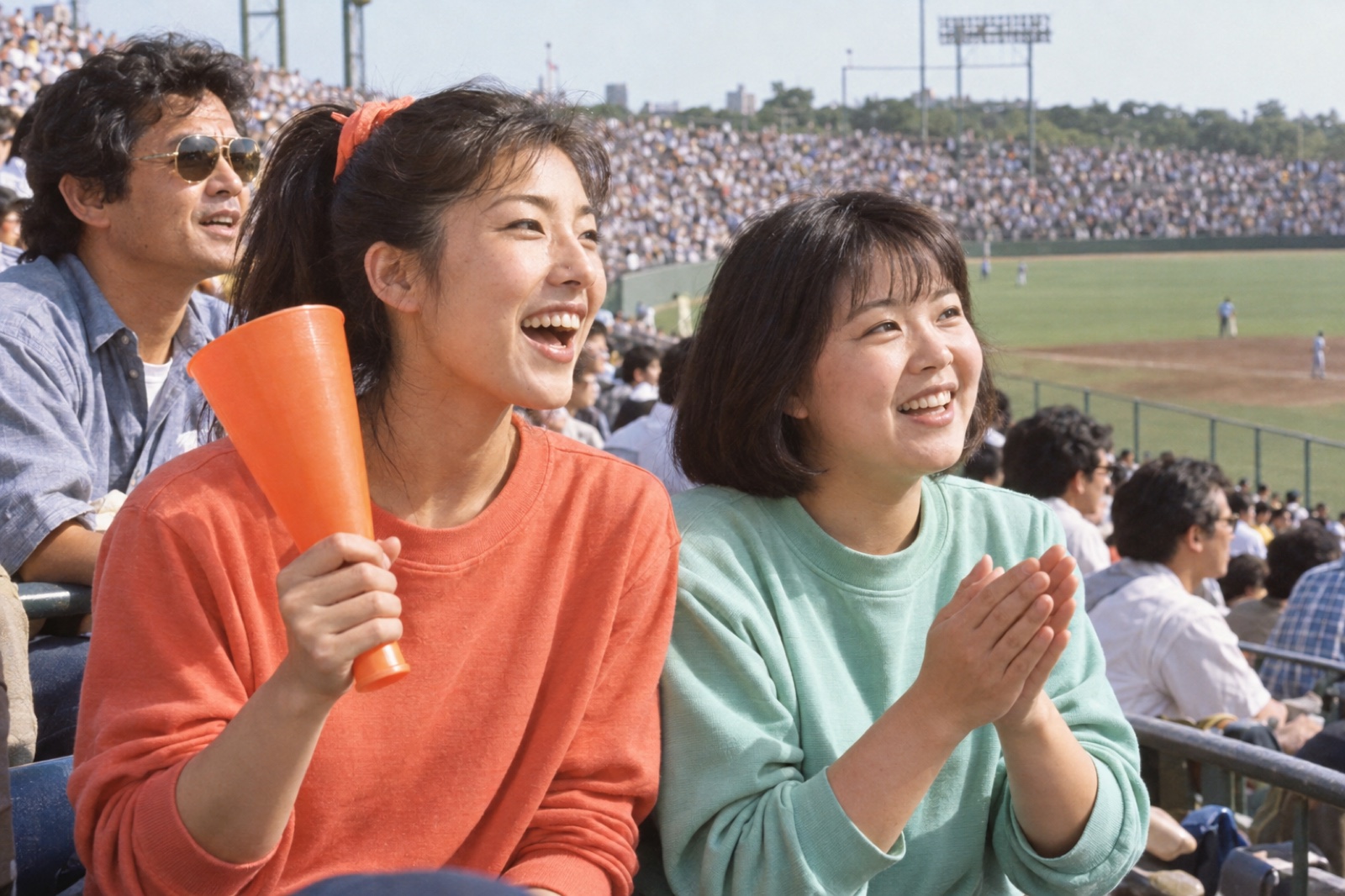
Fans followed idols on TV, teams in stadiums and, for some, each other over the phone line.
The Year’s Buzzword Awards
- New words · GoldBunshu ("splintered masses," people whose tastes divide into finer segments)
- Michio Kondo (President, Hakuhodo Institute of Life and Living)
- New words · SilverPerformance
- Masashi Ishibashi (Chairman, Japan Socialist Party)
- New words · BronzeNTT
- Hisashi Shindo (President, Nippon Telegraph and Telephone Corporation)
- Popular phrases · GoldIkki! Ikki! (a drinking chant, "Down it!")
- Representative of the Keio University athletic association
- Popular phrases · SilverTorakichi ("tiger fanatic," a devoted Hanshin fan)
- Yutaka Matsubayashi (head of a private Hanshin Tigers fan association)
- Popular phrases · BronzeKakunuki ("cutting out Kaku," i.e. shutting out Kakuei Tanaka)
- Head of the politics desk, Nihon Keizai Shimbun
- Popular phrases · Popular AwardNagetara akan ("You can't throw it")
- Keishi Suzuki (NHK baseball commentator, former Kintetsu Buffaloes pitcher)
- Popular phrases · Special Merit AwardAssorted buzzwords born from the comedy show "Oretachi Hyokin-zoku"
- Takeshi Yokozawa (Second Production Department, Programming Bureau, Fuji Television)
The gold prize in the new-word category went to “Bunshu” (“splintered masses”), a term coined by Hakuhodo Institute of Life and Living for the view that people’s tastes and hobbies were dividing into finer segments rather than a single uniform mass. The bronze prize went to “NTT,” the name of the newly privatized telephone company, and the trendy-phrase gold prize went to “Ikki! Ikki!” Jiyu Kokuminsha: winners of the second awards (in Japanese)
In 1986, solo careers spread from Onyanko Club, and Dragon Quest and the TV anime Dragon Ball arrived.
FAQ
How did Onyanko Club come about?
It was formed from the cast of Yuyake Nyan Nyan, a live Fuji TV program that began in April 1985. Fans watched the members on a weekday-evening show and cheered them on.
When did "Torakichi" become a buzzword?
At the second Buzzword of the Year awards (1985), run by Jiyu Kokuminsha, it won the silver prize in the trendy-phrase category. The recipient was the head of a private fan association for the Hanshin Tigers. A nickname for Hanshin fans was chosen as a word of the year.
Who won the Japan Record Awards in 1985?
According to the Japan Composers Association, the Grand Prix went to Akina Nakamori for "Mi Amore." The Best New Artist award went to Miho Nakayama for "C," the Best Star Award to the Checkers, and the Album Grand Prix to Yosui Inoue's *9.5 Carat*. The ceremony moved to the Nippon Budokan starting that year.
When did PC networking begin in Japan?
In May 1985, ASCII launched ASCII-NET as a trial service, one of the early commercial PC networking services. It was also the year that the Telecommunications Business Act took effect in April, liberalizing telecommunications so that companies could sell modems.
How big was Comic Market in 1985?
According to the chronology from the Meiji University Yoshihiro Yonezawa Memorial Library, the 28th event on August 11 had 3,450 circles and the 29th on December 29 had 4,000, each with an estimated 30,000 attendees. The 29th used two buildings, the East Hall and the West Hall.
When was Super Mario Bros. released?
September 13, 1985. You control Mario and advance through stages, and it became the signature hit of the Family Computer.


